Smart Heating Solutions
Bamboo Dishes may look like simple pieces of pale, finely grained plant material. Their composition, however, can vary considerably. Some are carved or laminated from bamboo strips; others use bamboo powder or fiber combined with binders. A product labeled “bamboo” may therefore contain more than bamboo. Check the material description, care instructions, and food-contact information before choosing a plate or bowl.
The market is growing, but broad figures need context. Grand View Research estimated the global bamboo market at approximately $68.8 billion in 2022, with projected growth through 2030. That report covers many bamboo products, not dishes alone. It signals wider commercial interest, not proof that every bamboo tableware item has the same makeup or environmental impact. That distinction matters.
Bamboo researcher Dr. Walter Liese has described bamboo as “a grass, not a tree.” This botanical distinction helps explain its rapid regrowth, but it does not tell us what a finished dish contains. Look closely. A smooth, glossy surface may come from a coating or binder, while visible grain can suggest a different construction. Appearance alone is not enough. Even product labels can be frustratingly vague. A useful guide should separate solid bamboo, laminated pieces, and molded composites, then explain what each material means for everyday use. The details are small, but they belong in the conversation. The goal is not to treat bamboo as automatically better; it is to understand what your dishes are actually made of.
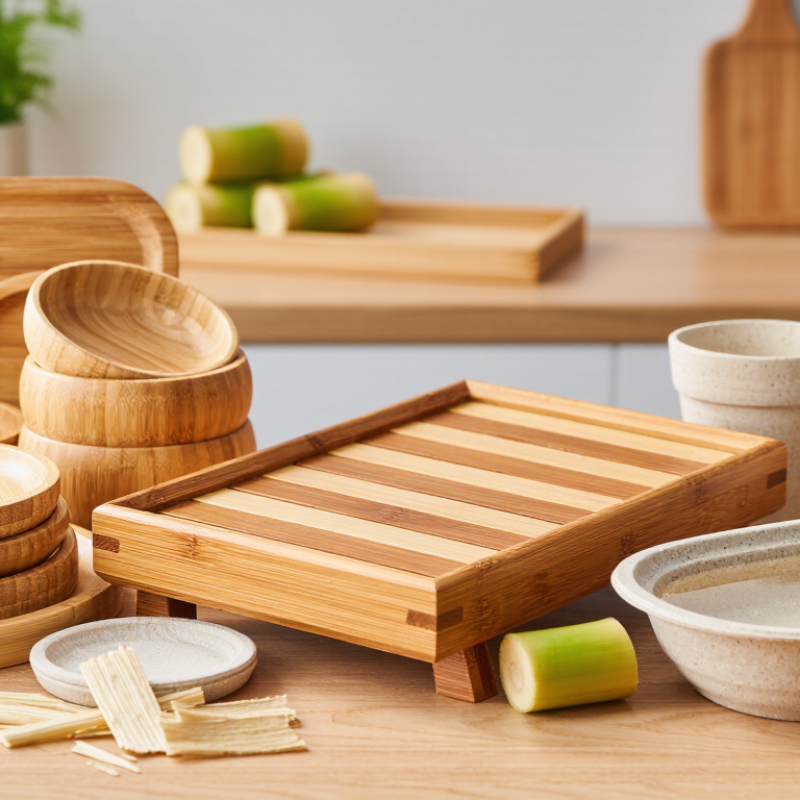
Bamboo dishes can be made from different species and plant parts, so the word “bamboo” does not describe one exact material. Moso bamboo, Phyllostachys edulis, is commonly used because its tall, strong culms provide substantial material. In other regions, manufacturers may use locally available species. The choice depends on supply, culm size, and the dish-making process.
The main part used is the culm, or hollow stem. Its woody walls can be cut into strips, layered, and pressed into shapes such as bowls or trays. For molded dishes, culms may instead be broken down into fibers or pulp. These fibers are combined with other ingredients and formed under heat and pressure. The outer culm surface may remain visible in some products, while processed pulp usually has a smoother, more uniform appearance. Small details matter.
Nodes—the raised joints along a culm—can affect how the stem is cut and processed, though they are not typically the feature that gives a finished dish its strength. Leaves and shoots are generally not the main structural material in rigid bamboo dishware. Still, product labels can be vague. “Bamboo” may mean solid strips, bamboo pulp, or a composite, and those materials are not interchangeable. A close look at the stated ingredients can reveal what the dish actually contains.
Turning bamboo into dishmaking material starts with selecting mature culms, then splitting and chipping them into smaller pieces. The pieces are pulped or mechanically separated into fibers, dried, and screened to remove oversized fragments. For molded dishes, manufacturers blend the dry material with a binder, then press it in heated molds. The binder matters: bamboo alone generally cannot make a thin, water-resistant plate. Some products are laminated from strips instead, so “bamboo dish” does not describe one exact recipe.
The International Bamboo and Rattan Organisation’s Global Assessment of Bamboo and Rattan Resources 2020 estimated about 35 million hectares of bamboo forest worldwide. That figure describes a broad resource, not the amount suitable for tableware. Processing also affects the final product: moisture control helps limit warping, while trimming and surface finishing remove rough edges. The material story is less tidy than a label may suggest. Check the product’s stated composition and food-contact instructions, especially when its binder is not clearly identified.
Tips: Look for a clear list of materials, not just “bamboo.” Keep dishes away from heat sources unless the care instructions allow it. Small details matter.
Bamboo dishes are not all made from the same material. Some are shaped from solid bamboo strips, then sealed with a food-contact coating. Others use thin bamboo layers bonded with adhesive. Small grain lines and visible seams can help identify these constructions, though finishes may hide them. The FAO’s Global Forest Resources Assessment 2020 estimated around 35 million hectares of bamboo worldwide. That figure describes bamboo resources, not the amount suitable for dish production.
Bamboo-fiber dishes start with bamboo processed into fine particles or fibers. These are often mixed with a binder and pressed into plates, bowls, or cups. The binder matters. Some products marketed as bamboo tableware are composites containing bamboo powder and melamine-based resin, rather than pure bamboo. Not the same material. A smooth surface can make them look alike, so check the material description and care instructions.
Composite dishes can be lightweight and neatly molded, but heat and wear deserve attention. Follow the maker’s stated limits for hot food, dishwashers, and microwaves; do not assume every bamboo item handles them safely. The label can be vague. I would look for clear details about the fiber content, binder, and intended use, then replace items with deep cracks or peeling surfaces. “Natural” sounds reassuring, but it does not tell you what holds the dish together.
| Feature | Natural Bamboo | Bamboo Fiber | Composite Materials |
|---|---|---|---|
| Typical composition | Whole bamboo culm, cut and shaped, or bamboo strips joined into a laminated form. A surface coating may also be used. | Finely ground bamboo or bamboo cellulose fibers, usually combined with a binder to form a molded item. | A mixture of bamboo-derived material and other ingredients, commonly a polymer resin. The exact formula varies by product. |
| How it is made | The bamboo is cut, dried, shaped, and finished. Laminated pieces are made by bonding strips together. | The plant material is processed into fine particles or fibers, blended with a binder, then pressed or molded. | Ingredients are mixed and formed through processes such as molding or pressing; some products use heat and pressure to set the resin. |
| Appearance and feel | Often shows visible grain or strip patterns, with a warm, natural feel. | May have a matte, slightly textured finish; the bamboo content may not be visible in the finished surface. | Can be smooth, colorful, or shaped into a range of designs. Appearance alone does not reveal its full composition. |
| Common advantages | Made largely from a renewable plant material and can be lightweight. Each piece may show natural variation. | Can use bamboo-derived material in molded shapes and may offer a lightweight alternative to some conventional dish materials. | Can be shaped into durable, consistent forms. Performance depends on the materials, formulation, and manufacturing quality. |
| Important limitations | May absorb moisture, warp, crack, or split if left wet or exposed to excessive heat. Coatings can wear over time. | Usually depends on a binder, so it is not necessarily made of bamboo alone. Heat tolerance and food-contact suitability vary. | May contain substantial non-bamboo material and is not automatically biodegradable or compostable. Check the product’s stated composition. |
| Heat and appliance use | Do not assume it is microwave- or dishwasher-safe. Follow the care instructions, especially if the item is coated or laminated. | Do not assume microwave or dishwasher compatibility. Some fiber products contain resin binders that are not intended for high heat. | Use only as directed. Products containing melamine-formaldehyde resin should not be used in a microwave or for heating food. |
| Care guidance | Hand-wash with mild detergent and dry promptly unless the maker specifies otherwise. Avoid prolonged soaking. | Follow the product label. Hand-washing and avoiding high heat are prudent when the binder and care limits are unknown. | Follow the product label and avoid heating unless explicitly approved for that use. Discontinue use if the surface becomes damaged. |
| What to check before buying | Look for details about solid or laminated construction, the finish or coating, and cleaning instructions. | Check whether a binder is used, the stated food-contact suitability, temperature limits, and care guidance. | Review the full material description, food-contact information, temperature limits, and any disposal or compostability claims. |
Bamboo dishes are often molded composites, not solid bamboo. Finely milled fibers are mixed with a binder, commonly melamine-formaldehyde resin, then shaped under heat and pressure. Pigments and other additives may provide color, flexibility, or a smoother finish. Looks simple. It isn’t.
The European Commission’s 2021 coordinated control plan examined 748 food-contact articles. It reported that 21% failed migration requirements for melamine and/or formaldehyde. That result concerned tested products, not every bamboo-fiber dish.
Surface coatings can add gloss, color, or a barrier, but they do not reveal the full material recipe. In some dishes, the resin binder also creates the hard, smooth surface. Heat matters: the German Federal Institute for Risk Assessment has warned that hot foods and drinks can increase the release of melamine and formaldehyde from these composites.
A shiny finish is not proof of a safer product. Nor does “bamboo” on a label tell you which binder or coating was used. For practical use, check the manufacturer’s food-contact instructions, avoid heating dishes unless explicitly permitted, and replace pieces with cracks or worn surfaces. I would still treat vague material descriptions cautiously; appearance alone tells us very little.
Bamboo dishes are not all made from the same material. Some are carved from solid bamboo, while others are molded from bamboo fibers mixed with a binding resin. The word bamboo alone tells you little. That matters. In fiber-based dishes, the resin and manufacturing quality affect how the item handles heat and repeated washing. A smooth surface can look reassuring, but appearance cannot confirm what binders were used or whether a dish is suitable for food.
Heat is the weak point. Not always. Check the care label before putting a dish in a microwave or dishwasher, especially if it is fiber-based. High heat can damage some resin-bound products, and scratches or chips may make a dish harder to clean thoroughly. Solid bamboo also needs care: prolonged soaking can encourage swelling or cracking, while thorough drying helps limit moisture damage. I would not treat every bamboo dish as interchangeable; that is an easy mistake. Choose products with clear food-contact and care information, and replace pieces that become rough, cracked, or visibly worn.