Smart Heating Solutions
Choosing a Trampoline Mat manufacturer involves more than comparing prices. Global buyers must assess material quality, stitching, dimensions, customization options, and production capacity. A mat may look sturdy in a product photo, yet its real value depends on clear specifications and consistent workmanship.
This guide introduces ten manufacturers for buyers seeking dependable sourcing options. It highlights practical details to compare, including fabric type, spring attachment design, available sizes, sample policies, and quality-control information. Ask suppliers how they check stitching strength and dimensional accuracy. Request product specifications, sample photos, and relevant test documents before making a large order. These steps can help buyers judge whether a supplier’s claims match the product offered.
Small details matter.
Lead times, minimum order quantities, packaging, and communication can affect a purchasing decision as much as the product itself. A low quote is not always the best deal. Nor does a polished website prove reliable production. Buyers should verify current capabilities directly, since product ranges and factory arrangements can change. This list is a starting point, not a substitute for due diligence. Some supplier information may also be incomplete or difficult to compare, which deserves a closer look. The right manufacturer depends on your market, order volume, and performance requirements. Use the profiles to narrow your options, then confirm specifications and terms in writing before committing.
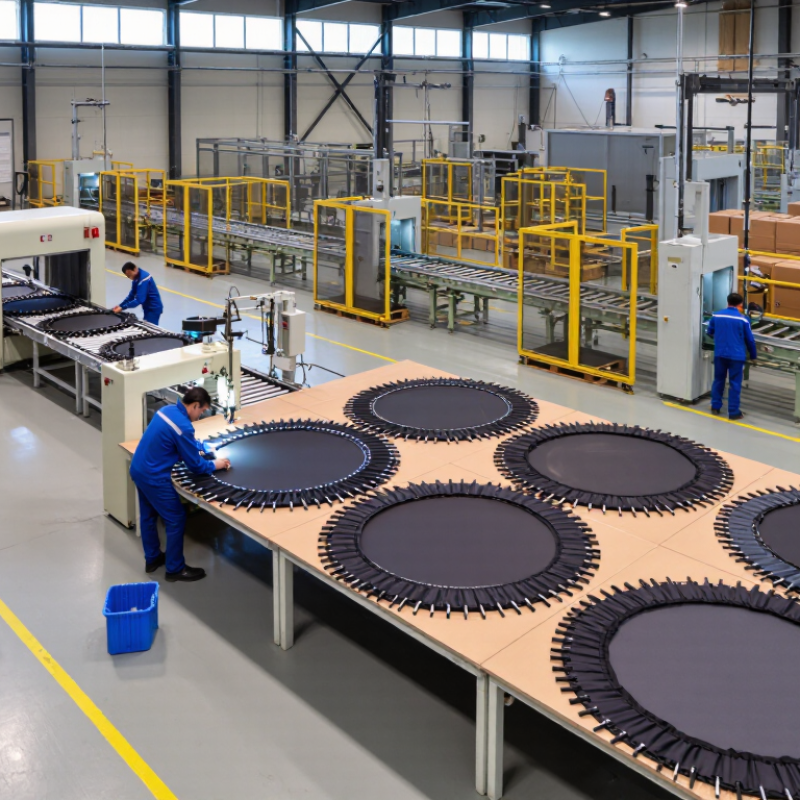
A trampoline mat is more than a jumping surface. Its mesh must balance airflow, flexibility, and resistance to repeated loading. Buyers should inspect the weave for uneven gaps, frayed fibers, and brittle areas, especially near the perimeter. Stitching matters just as much. Reinforced rows should hold the fabric loops or attachment points firmly, without loose threads or skipped stitches. Small defects can grow under repeated bouncing. Easy to miss.
CPSC-backed research using National Electronic Injury Surveillance System records estimated more than one million trampoline-related injuries in the United States from 2002 to 2011, or roughly 100,000 annually. These figures describe emergency-department visits, not mat failures alone. They are a useful reminder to assess the complete trampoline system, not just fabric strength.
ASTM F381, the Standard Safety Specification for Components, Assembly, Use, and Labeling of Consumer Trampolines, provides a relevant safety framework. It does not, by itself, prove that every mat is safe or suitable for every frame. Ask suppliers for test documentation tied to the intended trampoline model, and check that attachment spacing matches the frame.
A practical inspection should include the underside, where wear may be less visible. Check seams after installation and during routine maintenance. I would also question vague claims such as “heavy-duty” without test details.
ASTM requirements can guide evaluation, but choosing a mat still involves judgment. Sometimes the evidence is incomplete.
Sources: ASTM International, ASTM F381; CPSC NEISS-based trampoline injury research, 2002–2011.
For global buyers, a trampoline mat’s appearance reveals little about how it will perform after months outdoors. Request tensile test data for the fabric and stitched seams, not just a general strength claim. Check the sample size, test direction, conditioning, and failure load. A clear report lets you compare suppliers using the same method. Small details matter.
Tips: Ask for UV-aging results that show exposure conditions and changes in strength or color. For dimensional checks, compare mat diameter, attachment-point spacing, and edge symmetry before and after testing. Make sure the report identifies the tested sample and date.
Numbers need context. A high tensile result may not predict seam durability, while UV results vary with exposure settings. Ask whether the tested mat matches the production material, thread, and construction. Have a third-party lab verify samples when the order is significant, and keep a retained sample for later comparison. One report may look polished but still omit useful details. That gap deserves a follow-up question.
A useful comparison of ten trampoline-mat manufacturers starts with the fabric, not the catalogue photos. Most jumping surfaces use woven polypropylene; buyers should check yarn thickness, weave density, UV stabilization, and reinforced stitching. Look closely at the eyelets, too. Uneven spacing can pull the mat off-center under repeated loading. PlasticsEurope’s Plastics – the Fast Facts 2023 report recorded 400.3 million tonnes of global plastics production in 2022. That figure is not trampoline-specific, but it illustrates the scale of the material supply chain. A supplier’s material declaration and batch traceability matter more than broad claims of “heavy-duty” construction.
Production capability shows up in repeatability. Ask whether the factory controls mesh dimensions, seam strength, and finished-mat tolerances across production runs. Request test documentation, including relevant component checks under ASTM F381, and confirm the test applies to the product being offered. Small details count. A sample may have tidy stitching while bulk production varies. Market reach also deserves scrutiny: export experience, clear packing specifications, and access to replacement mats can reduce delays for international buyers. Compare stated delivery regions against actual references where possible. Price alone is a weak filter; freight, communication, and consistent quality can change the real cost. I would not rank suppliers on claims alone. Some production details remain hard to verify remotely.
For global buyers, a trampoline mat’s paperwork should match its actual use and construction. ASTM F381 addresses consumer trampoline components, assembly, use, and labeling; buyers should request the applicable test report, not just a supplier’s claim of compliance. Check that the report identifies the mat material, stitching, dimensions, and tested configuration. CPSC’s 2011 NEISS-based report estimated 83,400 trampoline-related emergency-department injuries in the United States. That figure is a reminder to examine safety evidence closely, though it does not measure mat failures alone.
EN 13219 covers gymnastics trampolines, so its relevance depends on the product type and intended setting. A certificate for a different model or test setup may offer little assurance. Ask for traceable test dates, sample identification, and any corrective-action records. ISO 9001 documents a quality management system; it does not certify a mat as safe or compliant with either product standard. Inspect the factory’s material controls and batch records, too. Small gaps matter. A tidy certificate can still leave unanswered questions about the fabric delivered today. Compliance review is strongest when documents, physical samples, and production controls tell the same story.
Reference edition years for three standards commonly considered in trampoline product and quality-system reviews. The chart does not represent manufacturer certifications or compliance status.
ASTM F381-16 is a consumer trampoline safety specification; EN 13219:2001 covers functional and safety requirements and test methods for gymnastic trampolines; ISO 9001:2015 specifies quality management system requirements. Edition years identify the references shown, not confirmation that they are the latest editions or that any manufacturer complies. Buyers should verify current editions, scope, and supporting documentation.
When comparing ten suppliers, look beyond the quoted unit price. Minimum order quantities can range from a few replacement mats to full production batches. Ask whether the MOQ changes by mat size, fabric, or custom stitching. A low MOQ may carry a higher unit cost, which can affect your landed budget. Details matter. Request a written quote with specifications and packaging included.
Lead times should distinguish sample approval, production, and shipping. A supplier’s estimate may not include delays caused by material shortages or peak-season demand. Warranty terms also need close reading: check coverage for seam failure, UV wear, and spring attachment points. Ask for test reports that match the actual mat material and model, with dates and testing scope clearly shown. A report alone does not prove every production batch is identical, so clarify how quality checks are recorded.
Tips: Compare like with like. Send each supplier the same dimensions, material requirements, and order quantity. Get delivery dates, warranty exclusions, and report details in writing. If one offer seems unusually fast or broad, ask what it leaves out.