Smart Heating Solutions
Choosing a Borosilicate Glass Sheet in 2026 requires more than comparing thickness and price. The right sheet must match heat, light, chemical exposure, and mechanical demands. A laboratory enclosure, oven window, solar component, and architectural panel may all need different glass grades.
Dr. James E. Shelby, a recognized glass science researcher, offers a useful principle: “Glass performance begins with composition, not appearance.” That statement deserves attention. A perfectly clear sheet can still fail after repeated thermal cycling. Small bubbles, edge chips, uneven thickness, or poor surface finishing can become serious weaknesses. Look closely.
Begin with the thermal expansion coefficient. Low expansion reduces cracking when temperatures change rapidly. Confirm the maximum continuous temperature, short-term temperature resistance, and thermal-shock performance. These figures should come from technical data, not sales language alone. Check them carefully.
Chemical durability also matters. Borosilicate Glass Sheet may resist water, acids, and laboratory chemicals, but resistance varies with formulation and exposure time. Ask for test methods, tolerances, and traceable batch information. Vague certificates are not enough.
Thickness selection needs practical judgment. Thicker glass improves stiffness, yet it adds weight and may complicate cutting or mounting. Larger panels need stronger support and better edge protection. This is often underestimated.
Optical quality can be decisive. Inspect haze, transmission, scratches, waviness, and coating compatibility under real lighting. Some projects overvalue perfect clarity while ignoring installation stress. That can be an expensive mistake.
A reliable supplier should provide samples, inspection records, packaging details, and responsive technical support. Compare the sheet after processing, not only before delivery. Specifications help, but field conditions can expose assumptions that looked reasonable on paper.
Borosilicate glass contains boron oxide, which lowers thermal expansion compared with ordinary soda-lime glass. It handles sudden temperature changes more reliably. A hot laboratory tray can meet a cool metal bench with less stress. It also resists many chemicals, making it useful for laboratory equipment, viewing windows, lighting covers, and precision instruments. It is not magic. Excessive impact can still cause failure.
In 2026, choose the sheet according to its real working conditions. Check operating temperature, temperature cycling, chemical contact, thickness, dimensions, and edge treatment. A thin sheet may improve light transmission, but a thicker sheet can provide better rigidity. Ask for thermal expansion data, optical specifications, flatness tolerances, and inspection records. Reliable suppliers should explain testing methods, not only provide attractive product photos. I have found that unclear edge quality often creates problems during cutting and installation.
Consider the complete design, not only the glass itself. Sharp corners, uneven frames, and concentrated fastening pressure may produce stress points. Rounded edges and flexible gaskets usually reduce local damage. If the sheet will face repeated heating, request thermal-shock testing under conditions close to actual use. A specification that looks excellent on paper may still be unsuitable in practice. Recheck the decision after a small prototype, because real assembly pressure can reveal weaknesses early.
Choosing borosilicate glass sheet starts with the application, not its label. Ask how quickly the surface heats, cools, and receives mechanical contact. Typical borosilicate glass has a low thermal expansion coefficient, near 3.3 × 10⁻⁶/K. This helps reduce cracking during temperature changes. It does not make the sheet immune to thermal shock. A sudden 250°C gradient can still cause failure, especially near scratches or drilled holes.
For ovens, laboratory covers, and viewing windows, verify the continuous service temperature and short exposure limit. Then check thickness, flatness, edge finish, and internal stress. A 3 mm sheet may suit a protected inspection window, but a larger unsupported panel needs stronger structural analysis. Chemical resistance matters when vapors, cleaning agents, or process liquids contact the surface. Borosilicate resists many acids and solvents, yet strong alkalis and prolonged exposure may attack the glass. Test the actual formulation.
Optical work adds another filter. Request transmission data for the wavelength range, surface quality, haze, and coating compatibility. Clear glass is not automatically suitable for ultraviolet or high-precision imaging. In production, I would inspect sample sheets after cutting, heating, and repeated cleaning cycles. Small edge chips often reveal more than a polished specification. One selection mistake is easy: choosing thermal resistance while ignoring mounting stress. Allow expansion, use compatible seals, and avoid point loading. Measure twice. Real applications are rarely perfect, and field feedback may force a change in thickness or finish.
How to Choose Borosilicate Glass Sheet in 2026?
Thickness, size, and surface quality should be compared together, not separately. ISO 3585 reports borosilicate 3.3 glass with a thermal expansion coefficient near 3.3 × 10⁻⁶ K⁻¹. This low expansion helps reduce cracking during temperature changes. However, thinner sheets flex more easily. A 3 mm sheet may suit a light cover, while a 6 mm sheet offers better stiffness for a larger panel. Actual load, support spacing, and heating speed still matter.
A common mistake is trusting the nominal thickness alone. ASTM C1036 addresses flat-glass thickness, dimensions, and visible blemishes, but supplier tolerances can differ. Measure several points with a calibrated micrometer. Check diagonal size too. A 500 × 500 mm sheet can become difficult to install when squareness is poor. Leave practical clearance for frames and thermal expansion. Cutting after delivery may not produce the same edge quality as factory processing.
Surface quality depends on the application. For laboratory viewing, inspect scratches, bubbles, stains, and roller marks under controlled lighting. For optical or sealing work, request flatness, waviness, and roughness data, preferably with measurement methods stated. ASTM E438 provides guidance for borosilicate laboratory glass, but it does not replace a project-specific inspection plan. I would also question unusually low prices. The coating, edge finish, and inspection report may be missing. No single specification solves every use.
How to Choose Borosilicate Glass Sheet in 2026?
Thermal performance should be checked before thickness or price. ISO 3585 lists a linear thermal expansion coefficient near 3.3 × 10⁻⁶ K⁻¹. This low value helps the sheet resist rapid temperature changes. However, it does not make the glass immune to thermal shock. A cold sheet exposed to a hot metal clamp may still crack. ISO 3585 also places the softening point near 820°C. Do not treat that figure as a safe working temperature. Support design, heating speed, and temperature gradients matter more than one impressive number.
Chemical resistance needs a separate test. Under ISO 719, borosilicate glass can meet hydrolytic resistance class HGB 1. That result indicates strong resistance to water attack, especially during laboratory storage. It does not guarantee resistance to concentrated alkalis, hot phosphoric acid, or repeated cleaning cycles. Request chemical compatibility data at the actual temperature and exposure time. A clear surface can hide early leaching.
Mechanical performance is often underestimated. ASTM C1499 evaluates flexural strength through biaxial testing, but real sheets rarely experience perfect laboratory loading. Scratched surfaces and sharp corners reduce reliability. Inspect the edges under angled light. Tiny chips matter. I also prefer specimens tested after cutting, washing, and thermal cycling. This is less convenient, but it reflects field conditions better. One weakness remains: published strength values vary widely with surface finish, so a single certificate should not end the investigation.
| Performance Dimension | Typical Data for Borosilicate Glass 3.3 Sheet | How to Check the Performance | Selection Guidance |
|---|---|---|---|
| Coefficient of Thermal Expansion | Approximately 3.3 × 10⁻⁶ K−1 from 20–300 °C | Review the material certificate and test method, typically based on dilatometry such as ISO 7991 or ASTM E228. | Choose a low-expansion grade when the sheet will experience repeated heating and cooling or must be joined to metals, ceramics, or other glass. |
| Strain Point | Approximately 510–525 °C | Confirm the reported strain point on the technical data sheet; it is determined from viscosity–temperature behavior. | The sheet should remain below its strain point during normal service to reduce the risk of permanent thermal stress. |
| Annealing Point | Approximately 555–570 °C | Check the grade specification and whether the sheet was properly annealed after forming or cutting. | Proper annealing is important for large sheets, drilled sheets, and parts exposed to temperature gradients. |
| Softening Point | Approximately 815–830 °C | Verify the softening point from the supplier’s technical documentation; do not use it as the normal operating temperature. | Use this value to understand forming limits, not as a continuous-use rating. Actual service temperature must also consider load, time, and thermal gradients. |
| Recommended Continuous Temperature | Often about 450–500 °C for an uncoated, properly designed sheet; application-specific limits apply | Evaluate the complete temperature cycle, sheet size, thickness, edge condition, mounting method, and thermal gradient. | For rapid temperature changes or localized heating, perform a thermal-stress calculation or practical qualification test instead of relying only on a single temperature value. |
| Thermal Shock Resistance | Commonly rated around 160–180 K for suitable borosilicate articles; sheet geometry and edge quality strongly affect the result | Use a controlled heating–cooling test with the actual thickness, dimensions, support, and edge finish. Inspect for cracks after cycling. | Select finer edges, polished edges, and adequate thickness for severe thermal cycling. Avoid sharp notches, chips, and rigid point mounting. |
| Thermal Conductivity | Approximately 1.1–1.2 W/(m·K) near room temperature | Check the declared value at the relevant temperature because thermal conductivity changes with temperature. | Borosilicate glass has relatively low thermal conductivity; design for temperature uniformity when fast heat transfer is required. |
| Visible Light Transmittance | Typically about 90–92% for clear, polished thin sheet; thickness, iron content, surface condition, and wavelength affect the result | Request spectral transmission data for the actual thickness and measure with a spectrophotometer when optical performance is critical. | For optical or display applications, specify thickness, wavelength range, surface quality, haze, and allowable inclusions separately. |
| Refractive Index | Approximately 1.47 at the sodium D line near 589 nm; exact value depends on composition and wavelength | Check the refractive-index value at the operating wavelength and temperature. | Use wavelength-specific data for lenses, sensors, imaging windows, and optical assemblies. |
| Hydrolytic Resistance | Typically Hydrolytic Resistance Class 1 under ISO 719 for borosilicate glass 3.3 | Request an ISO 719 test result or equivalent water-resistance report for the exact formulation. | Class 1 is appropriate for contact with water and many aqueous solutions, but it does not guarantee resistance to every chemical or cleaning process. |
| Acid Resistance | Generally high against many mineral acids, excluding hydrofluoric acid and hot concentrated phosphoric acid; alkali-containing chemicals may attack the surface | Test the actual chemical at its concentration, temperature, exposure time, and flow condition. Examine weight loss, haze, and surface roughness. | Never specify borosilicate glass for hydrofluoric-acid service. Consider a coating or an alternative material for aggressive acid or alkaline environments. |
| Alkali Resistance | Good compared with ordinary soda-lime glass, but prolonged exposure to strong hot alkalis can cause surface corrosion | Use a chemical compatibility test based on the real alkaline solution and temperature rather than relying on a generic resistance label. | For hot caustic cleaning, specify exposure limits, cleaning frequency, and allowable surface change. |
| Density | Approximately 2.23 g/cm³ at room temperature | Verify the value in the material certificate; calculate mass using actual dimensions and thickness tolerance. | Use density to estimate handling loads, frame loads, shipping weight, and the mass of large panels. |
| Young’s Modulus | Approximately 63–65 GPa | Check the modulus used in the design calculation and confirm the supported-span and loading assumptions. | Glass is stiff but brittle. Deflection, support spacing, edge contact, and local stress must be considered together. |
| Poisson’s Ratio | Approximately 0.18–0.22 | Use a verified material value in finite-element or plate-bending calculations. | Include this value when calculating bending stress, deflection, or thermal stress in restrained sheet assemblies. |
| Flexural Strength | Commonly about 30–70 MPa for annealed glass, depending strongly on surface and edge condition | Use a standardized four-point or three-point bending test, such as ASTM C158 or EN 1288, with the intended edge finish. | Do not treat flexural strength as a fixed material constant. Scratches, chips, drilled holes, and handling damage can reduce strength substantially. |
| Compressive Strength | Typically about 700–1,000 MPa in idealized material data; practical design values must be much lower | Assess the actual contact area, loading alignment, surface damage, and restraint. Avoid concentrated point loading. | Glass tolerates compression better than tension, but uneven supports can create tensile stresses and cause sudden fracture. |
| Vickers Hardness | Approximately 4.5–6 GPa, depending on test load and composition | Compare Vickers hardness data using the same test load and method; inspect the surface for scratches after handling. | Hardness does not equal scratch-proof performance. Use protective films, clean handling, and suitable packaging for finished sheets. |
| Surface Quality | Should be specified by allowable scratches, digs, haze, pits, bubbles, stones, and inclusions rather than by the word “clear” alone | Inspect under controlled illumination and compare with an agreed visual standard or optical-quality specification. | Optical windows require tighter surface and inclusion limits than furnace covers, laboratory panels, or general protective shields. |
| Thickness and Dimensional Tolerance | Must be defined according to the intended use; thickness uniformity affects optical distortion, mass, and thermal stress | Measure multiple points with a calibrated thickness gauge and verify length, width, squareness, flatness, and edge condition. | For large or precision panels, request thickness mapping and flatness data instead of checking only one point. |
| Edge and Hole Quality | Ground, fine-ground, or polished edges are safer than sharp cut edges; drilled holes require rounded transitions and adequate edge distance | Inspect for chips, vents, checks, star cracks, and grinding marks. Confirm hole diameter, position, chamfer, and edge distance. | Edge finishing is one of the most effective ways to improve practical mechanical reliability and reduce crack initiation. |
| Thermal Tempering Option | Heat-treated borosilicate sheet can have higher bending strength and better thermal-shock performance, but it is not unbreakable | Request the heat-treatment classification, surface compression value if applicable, flatness, optical distortion, and fragmentation requirements. | Use heat-treated glass where impact or thermal loading is significant, while remembering that cutting and drilling generally must be completed before tempering. |
| Recommended Documentation for Purchase | Composition or grade designation, thickness tolerance, thermal data, chemical compatibility, mechanical data, surface quality, edge finish, and inspection records | Compare the supplier’s certificate with the purchase specification and test reports for the actual batch when qualification is critical. | A complete specification is more reliable than selecting only by the words “heat-resistant” or “chemical-resistant.” |
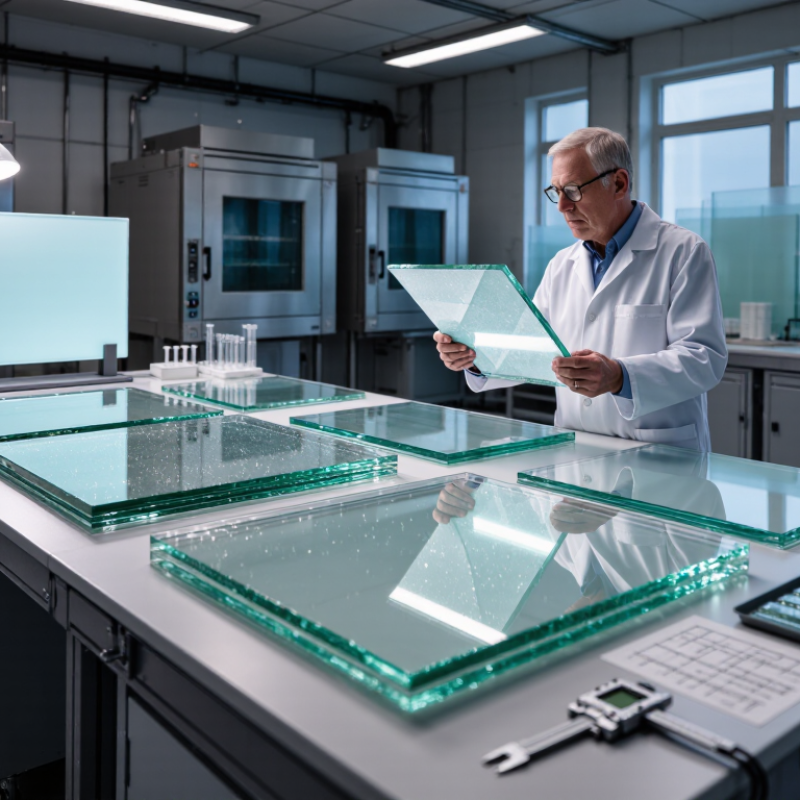
A reliable supplier should provide batch traceability, dimensional tolerances, and recent inspection records. Ask for the glass grade, thermal expansion data, and chemical resistance details. For borosilicate 3.3, ISO 3585 can support material verification. ISO 9001 may show quality management, but it does not certify every sheet. Request independent test reports when the application involves heating, pressure, or repeated temperature changes. Samples matter. A clear sheet can still hide uneven thickness or edge stress.
Cost needs careful comparison. A low quotation may exclude cutting, polishing, protective film, packaging, freight, or import charges. Request an itemized offer with currency, payment terms, minimum order quantity, and replacement conditions for transit damage. Compare usable area, not only price per square meter. In practice, a cheaper sheet may create more waste after cutting. I have seen buyers overlook edge finishing and pay more during installation. That mistake is easy to repeat.
Delivery performance depends on more than a promised date. Confirm available stock, production capacity, inspection time, packing design, and shipping route. Ask whether the supplier can send a pre-shipment inspection report and photographs of the packed crates. Wooden cases, separators, and moisture protection should match the transport conditions. Allow time for customs procedures and possible breakage. Fast delivery sounds attractive. It is not always safer. A small trial order can reveal communication gaps, inconsistent packaging, or changing lead times before a larger purchase.